A desktop HUD that automates the last mile of shipping software — the code-signing ceremony. Then it signed its own release build, and survived a five-way attempt to break that signature.
Signet signs any application; the standout demonstration is that it signed its own release build and survived a five-way adversarial verification. Named on July 16, that self-signed, verified build was done by July 18. The first working signing engine existed within the opening afternoon — the speed came from holding the architecture and driving the build against it.
Named "Signet" and sketched the vision: a heads-up display that runs the whole signing ceremony and asks for a human only at the one moment it matters — the physical key-touch.
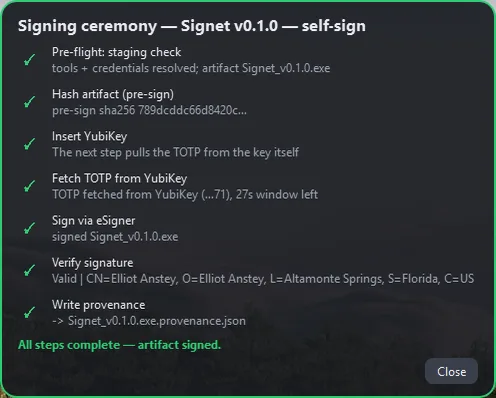
Within the first session: the frameless bubble HUD, a step-engine ceremony on a worker thread, and a real Authenticode runner — YubiKey TOTP → cloud-HSM sign → verify → provenance. By that evening it could actually sign. This is also where the architecture landed: the signer follows the distribution, not the other way around.
Traced and killed a Qt cross-thread deadlock with a watchdog; added a manual-OTP fallback; built the distribution-profile system so each channel gets the correct stages and the correct signer; and calibrated the one-time-code timing to measured latency.
Fixed the last hardware-key edges — a touch-required parse quirk, clock skew — and put a valid, timestamped signature on a real release. Then drew the mark: a sealing-wax seal with a twisted-rope rim and the Elder Futhark rune Sowilō (ᛊ) — the rune for the "s" sound, and so for Signet — generated procedurally, and compiled Signet to a standalone 22 MB binary with the seal embedded.
A signing tool that can't sign itself is just talk. The moment it compiled, the next move was obvious — the compiled Signet ran its own ceremony and produced a valid, trusted, timestamped signature on a Signet release.
Claiming "it's signed" is cheap — so I attacked it five ways, including a tamper test that flips a byte and confirms the signature fails. It failed exactly as it should; the real file passed every check. Idea to a code-signing product — signed by itself, adversarially verified: three days.
The problem. Signing a release is the fragmented last mile of shipping software. After the build, a developer faces a manual gauntlet — the right signing tool for each artifact type, hardware two-factor, cloud-HSM credentials, RFC-3161 timestamps, signature verification, a provenance record — performed by hand, and differently for every distribution channel. It's slow, easy to get wrong, and disconnected from the otherwise-automated pipeline.
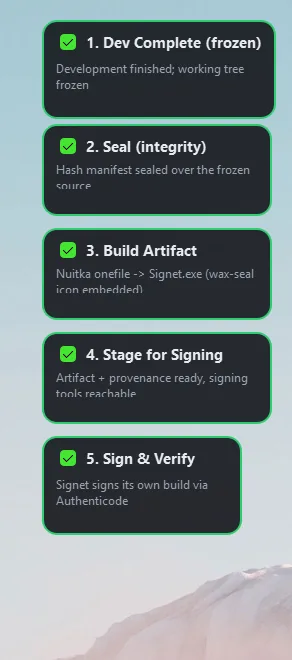
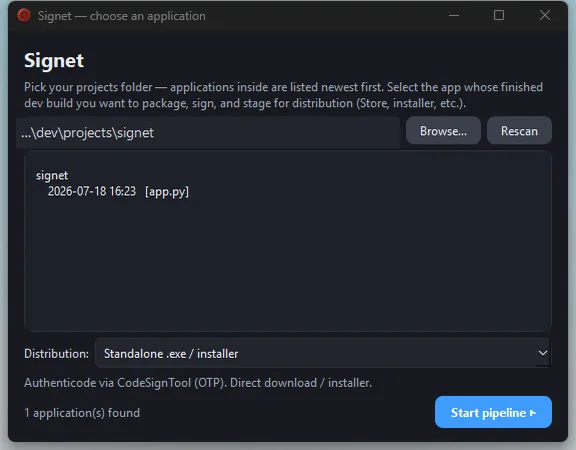
The solution. Signet is a desktop heads-up display for that last mile. Stage bubbles float at the edge of the screen, tracking a build toward production-ready; when it's staged, one Complete & Sign runs the ceremony — pull a fresh one-time code from a YubiKey, sign through the cloud HSM, verify, and write a provenance record — pausing only for the single moment a human is needed: the physical key-touch. Distribution profiles make it channel-aware, because the signing method is a property of the distribution, not the tool.
The value. It produces genuinely production-ready artifacts — a timestamped, trusted-chain
Authenticode signature that signtool verify /pa passes with zero errors — from a click and a
key-touch. It's self-hosting, and it's engineered to be trusted with a security-critical job: a
no-single-point-of-failure key model, crash logging behind a single-instance guard, and hardened handling
of the hardware, timing, and platform edge cases that make real-world signing brittle.
stack: Python · PySide6 (Qt) · SSL.com eSigner (CodeSignTool / eSigner KSP) · Windows signtool · YubiKey OATH-TOTP · Windows DPAPI · Authenticode + RFC-3161 · packaged with Nuitka.

I'd built a tool whose sole purpose is to sign and ready an application for distribution. So the thought that followed was almost inevitable: well — if this thing is going to be official, it's going to have to sign itself. So I pointed it at its own release build and let it run its own ceremony.
It's not a gimmick; it's the strongest possible statement of confidence. If the tool can put a genuine, verifiable signature on a 22-megabyte binary, then that binary — itself — is fair game. Signing itself was never the goal — it's the proof the tool works.
"It's signed" is a claim. So I tried to break it — five independent checks, each attacking a different failure mode, each told to refute the signature rather than confirm it. Every one held.
| Attack angle | What was attempted | Verdict |
|---|---|---|
| Policy verify | signtool verify /pa /v · /all | 0 errors, 0 warnings |
| Chain & revocation | .NET X509Chain, online revocation, entire chain; root checked in both trust stores | trusted, not revoked |
| Tamper test | flip a single byte in a copy — the signature must fail | rejected · HashMismatch |
| Timestamp | signtool verify /pa /tw | valid through 2034 |
| Signer & bytes | cert thumbprint + subject; file SHA-256 vs the signed provenance record | exact match |
The decisive one is the tamper test: flipping a single byte in a copy dropped verification to
WinVerifyTrust 0x80096010 / HashMismatch, exactly as it should — proving the passing result on
the real file is meaningful, not a tool rubber-stamping whatever it's handed. The signature chains
to a publicly-trusted SSL.com root (present in the machine's trusted-root store), carries a valid RFC-3161
timestamp so it survives the signing certificate's 2027 expiry, and the file's bytes match the SHA-256 in
its own provenance record. Two independent verification stacks and five adversarial lenses agreed: it holds.
A few of the real problems solved along the way: